Ankle Instability
Definition
Ankle instability is a broad term which includes functional weakness of the muscles around the ankle, as well as tears of the ligaments which normally provide support
Anatomy
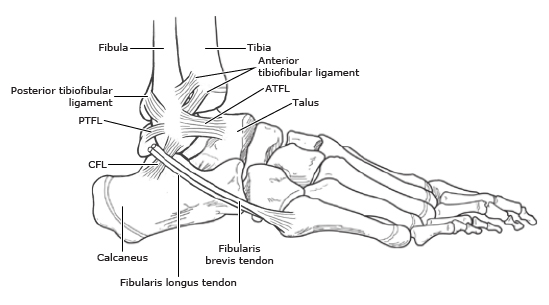
The muscles of the outer aspect of the ankle (lateral side) include the peroneus longus and peroneus brevis muscles. Both of these muscles are responsible for outward movement of the foot (eversion), and resist inward twisting of the foot (inversion).
Three main ligaments help to stabilize the lateral ankle:
Anterior Talofibular Ligament (ATFL) is the most commonly injured
Calcaneofibular Ligament (CFL) prevents tilting of the ankle, and may be injured in severe ankle sprains
Posterior Talofibular Ligament (PTFL) is rarely injured
Symptoms
Symptoms may vary from occasional “popping” while walking, especially on uneven ground, to frank “giving way” and falling while walking or playing sports.
Causes
Ankle instability may be the result of one acute traumatic event, or the result of multiple recurrent injuries to the ankle. These are usually inversion injuries (twisting of the foot and ankle inwards).
Treatment
Initial treatment of ankle instability involves rehabilitation, with emphasis on strengthening of the muscle-tendon units with specific exercises and physical therapy. Ankle braces are often used. Modification of shoes to include lateral heel flares or lateral heel wedges may improve stability.
If instability persists after completion of a non-surgical protocol, surgery may be required. Surgery for ankle instability usually involves a repair of the torn ankle ligaments. The peroneal tendons are also often involved, and may require surgical removal of inflammatory tissue and repair of the tendons.
Arthroscopic (Minimally Invasive) Surgery
For patients who require lateral ankle stabilization procedures, we offer arthroscopic surgery. The advantages to arthroscopic surgery for lateral ankle stabilization include:
Minimally Invasive
Allows for earlier weight bearing
Allows for earlier physical therapy and rehabilitation
Allows for concurrent treatment of intra-articular pathology, such as cartilage defects and synovitis (inflammation) within the joint
Keeps the joint capsule intact and available for use in repair
Dr. Baker has been performing this surgery for over 10 years, and was the first surgeon in Tucson to use this technique. He has published peer-reviewed studies on this topic, has taught numerous colleagues this approach, and has lectured extensively on the topic.